5: Many ‘creators' are ‘corporate’
Category errors occur when we ascribe characteristics of some to the whole. They often occur when we aren’t clear about what characteristics bind categories. A lot of thinking about the ‘creator economy’ suffers from this problem and it is preventing the development of smart thinking and strategy.

The so-called creator economy is the center of media industry attention, but its edges are unclear. Some offer thoughtful definitions but make the category too broad; definitions from general consulting firms’ reports range from absent to arbitrary. To be fair, we’ve had poor categorization in this area for two decades – old v new media; user/amateur v professional; short v long form – and stronger conceptualization is well overdue.
Creator v corporate has grown common and is no more helpful. Some creators are corporate, and there are a few different media businesses within what is being called the creator sector. Poorly demarcated categories lead us to misunderstand. We assume attributes of some to be true of all. We compare apples and oranges and waste time devising strategy trying to make the apple more like the orange which fails to solve the problem because inherent differences separate citrus and pome fruit.
The ‘creator economy’ is most commonly used to refer to media making outside of legacy media companies (the implied ‘corporate’ media) that relies on hosted media platforms for distribution/monetization (YouTube, Substack, Patreon, etc). But the concept is most useful for distinguishing just that second bit – relying on hosted media platforms for distribution/monetization.
A conceptually stronger industrial category distinction is between ‘hosted’ v. ‘licensed’ (first discussed by Idiz and Poell here as hosted v commissioned, but I’m going to build from what they’ve written). The key operational difference crucial to enabling a media sector that operates in a way very different than the past is the emergence of services that merely ‘host’ content. Historically, most media content was licensed through a formal contract involving remuneration between the maker and distributor [No, Terms and Conditions are not comparable to a ‘license’ in this use; this is ‘license’ in a media business sense not a software sense. It encompasses ‘commission’, which I use to mean to pay for the creation of media content. License in media businesses might involve commission-level funding or payment to distribute content. Payment is key].
Hosted distribution is very different from how the predigital media sector and what we’ve called ‘legacy’, ‘old’, and ‘corporate’ media work; in a ‘licensed’ media environment, distribution largely required a formal contract-based relationship between the maker and distributor, often with some level of guaranteed remuneration for content. It also included a negotiated agreement of ownership rights that impacts that remuneration process. For example, television channels either produce or license titles to fill airtime; newspaper and magazine publishers develop or commission their editorial content.[1]
We may flippantly regard these licensors as ‘gatekeepers’ and critique them for limiting what media can be made and what users can access. But they limit funding and access because they take on some of the high risk of media goods and ensure some remuneration for the content maker – reducing the content maker’s risk. They also take on reputational risk.
The aspect of media business that is most radically changed is that so many media makers are now willing to bear all the risk of their media making. This is a meaningful, structural difference in business operation worthy of a distinct category of operation.
Hosted v licensed media economics
The business of media making works very differently for media that are hosted versus licensed, particularly in the dynamic of financial risk and reward. Hosted media requires a creator to take on the costs of making something with no guarantee of payment. That’s the risk piece; it lies nearly entirely with the media maker. In a hosted arrangement, the maker may be highly rewarded in success – depending on the policies and terms of the distribution service (rewarded either through revenue share, external rewards such as brand deals, or building a consumer-funded business). Unsurprisingly, reward is correlated with risk – making hosted media risks not earning anything.
Licensing reduces the maker’s risk because some level of remuneration is involved so that the maker and distributor share risk. Licensing also typically requires shared reward because the distributor bears risk in guaranteeing the contracted sum; in cases where makers bear no risk (costs are fully covered by the distributor), there may be little or no reward for the maker in great success because they shouldered no risk.
It isn’t a matter of hosted v licensed, just hosted or licensed. They are not in opposition; they describe different relationships between media makers and distributors that affect the experience of media making and what can be made. This is a useful categorization because it is objective – either there is or isn’t an underlying contractual relationship in which the distributing service takes on some of the media maker’s risk. The formality of that relationship defines two categorically different experiences like a fork in the road.
It can also be used flexibly; we can talk about projects being hosted or licensed to reflect how many media makers and their companies may pursue work under both conditions. It also addresses the variability across services as not all makers are treated the same within a single platform (YouTube Partners), and there is variation within types of services (neither ‘TV’ nor social media offer consistent deals). Beast Games is a licensed media product while Mr Beast’s YouTube channel is hosted; we already see a lot of media makers spanning the chasm with a portfolio of work and we will likely see more.
The creator v corporate media dichotomy fails to reliably map onto the hosted v licensed distinction, although five or ten years ago it may have seemed to. By the mid 2020s, a fair bit of the ‘creator’ sector is hosted but underpinned with business structures that look pretty corporate even if they are separate from predigital era companies. For some, creator v corporate has stood in for ‘everything that is not legacy media’ v legacy media, and that’s not helpful. Moreover, there is a lot of variation in creator/hosted media businesses and more and more looks quite like ‘corporate’ media, in which corporate indicates small-to-medium size enterprises (SME) with more than a handful of salaried employees. There are big differences between the individual entrepreneurs that ‘creator’ brings to mind and companies with payrolls, HR departments, and an increasing range of investment.
Hosted and licensed media-making have different costs, opportunities, and risks that are tied to the hosted v licensed distinction and that is what makes it a stronger way of categorizing.
Moving beyond the creator v corporate dichotomy is important because it hides variation in strategy and media-making businesses within the 'creator' category. The dichotomy is most often invoked to proclaim the creator economy as a bright shiny object of financial growth that is the future of media content businesses. Sometimes this is an argument to advertisers to spend more of their budgets on YouTube; sometimes it seems aimed at shaming legacy players into recognizing that the playing field has irreversibly changed and their businesses must evolve. But if we want to understand how the business of making media has and will continue to change, we need more categories and clearer and reliable distinctions.
We need to acknowledge the different challenges hosted media work present to the sole proprietor versus to companies that may not be all that different than the SME that have long been part of the media industries. Distinguishing between these very different realities is the only way to understand the risks and opportunities in this sector or the financing and operations that best lead to sustainability and an optimal environment for media making. [To be clear, my interest here isn’t how to make the most money per rapacious capitalism, it is how to create better balance between creative and commercial components to enable an array of creativity that supports socio-cultural needs of makers and users in a financially sustainable way].
The lines between the corporate and creator economy have not been well defined nor do these terms emphasize the characteristics that reliably bind the categories. Avoiding category errors requires clarity about what we mean for categories to accomplish. Admittedly, the new/user-gen/short/creator sector and its dynamics have changed a lot in the last two decades, which has made it difficult to grasp the most meaningful distinctions upon which to base organization and suborganization of media sectors. It is clear that hosted distribution is the most meaningful distinction.
A lot of the creator v corporate discussion also focuses on video/YouTube; it is helpful to have categories that transcend media and are useful in understanding Substack/Ghost.io, app stores, and the full range of media economies enabled by hosted distribution. We need more precise conceptualization to understand, develop strategy, and speak intelligently about what is happening now that the internet-distributed media ecosystem is more mature. And we need subcategories too…
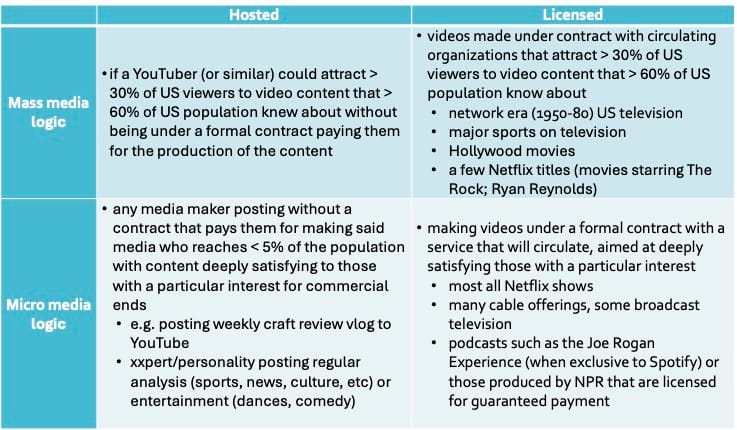
Coda: Hosted/Licensed v Mass/Micro
Crucially, hosted v licensed is a distinction based on industrial practice: it characterizes features of the business model. This operates independently of the distinction between mass and micro media, which characterizes the scale of media consumption within a society. Mass media and micro media logics describe strategies designed for making goods under different conditions. Hosted v licensed is an independent distinction though strong correlative tendencies exist. By the mid 2020s, most hosted and licensed media reached micro audiences relative to historical norms. Truly mass reach is rarely achieved by hosted media – I’m not certain of an example though there is nothing in hosting that prevents it. Mass media reach has just become most extraordinary in a media ecosystem of such abundance.
[1] Sectors tend to work certain ways but there are often exceptions. For example, FAST channels might seem like ‘TV’ but – since many rely on already produced and monetized content – some can operate on a hosting model (no upfront money, just revenue share). In this case, set manufacturers or other MVPD or MVPD-ish services are the platform/service hosting.