3: Requiem for mass media
Many concepts of 20thC media culture went undefined because they seemed obvious. The bounds of ‘mass media’ were easy to observe and intuit, and it was difficult to imagine an alternative. The media sector has struggled to evolve its business because it has believed that 21stC hits are mass media.

What do we even mean when we reference ‘mass media’? Lots of things, which stokes the confusion. Most basically, we might mean media content widely consumed: in the predigital US, widely consumed television shows were watched by 30% of the population. But ‘mass media’ is often used to describe more than media that is widely consumed. Sometimes it refers to the underlying logic of the twentieth-century commercial operating structure (mass media logics). And mass is also sometimes used as an adjective to describe content features characteristic of that operating structure.
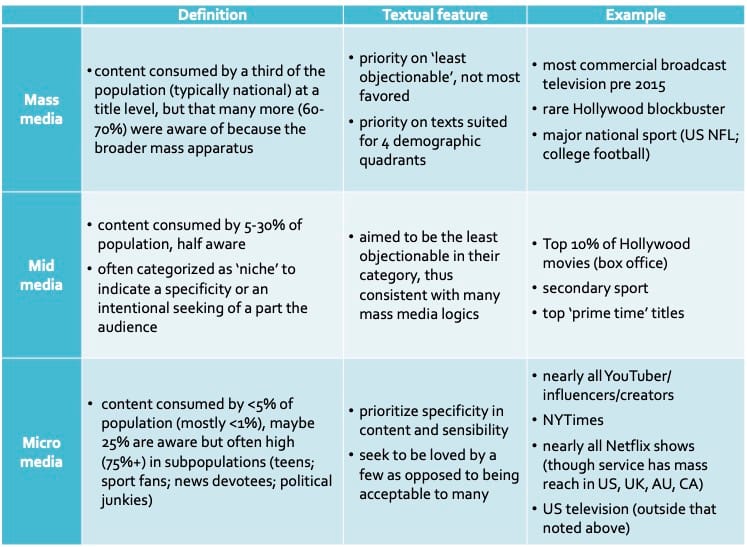
It is difficult to fully evidence the scale of media fragmentation that spreads what was once condensed attention to a narrow array of media across thousands, if not hundreds of thousands, titles, messages, videos and individualized feeds. But to my thinking, nearly all media consumption is better understood as characteristic of a micro media experience now (see Fig 3.1).
Mass media didn’t end in any year; there are still occasional instances. In the US, the dominance of mass media logics was eroding in the 1990s, and the balance of mass to micro has long varied across different media industries (broadcasting as most mass) and national contexts. This is a particularly US-based and television-centric version of the story, in which the turn of the century provides a significant inflection point when mass media logics became clearly challenged and increasingly ‘residual’ rather ‘dominant’.
Mass media ‘logics’ emerged from specific technological, regulatory, and business practices in the twentieth century that led to certain expectations of what media could or should be. Those working in media, as well as users, regarded the operational logics and features of media content produced by this system as ‘normal.’ But they weren’t normal: they just aligned to operational conditions of the time such as the technological capacity of analog-era distribution, and in the US, a largely nonregulatory policy context, access to high levels of investment capital, and availability of a great deal of advertiser funding. For those who knew that world – which still includes the geriatric executive corps at a stunning number of media companies – it has been difficult to recognize that the conditions that allowed for those media business norms – as well as their profit margins – are gone and cannot be recreated by businesses based in making media content.
Mass media logics included strategies like creating artificial scarcity and price discrimination to try to drive up what the most passionate media users would pay while still leveraging the economies of scale available to this peculiar industry with low-to-no marginal costs. The sector engaged widely in intentional overproduction in response to the ‘riskiness’ of a business in which ‘nobody knows’ what will hit. The scarcity of the era made it possible to channel audience behavior and drive attention to new content by making it adjacent to known hits. Discovery (called promotion then) was easier because users regularly stopped by only a few channels and the comparatively few goods were being promoted to everyone. The scarcity of ‘channels’ and the schedule well suited advertisers’ desire to reach large audiences at specific times, creating a system symbiotic for business interests. Users arguably weren’t well served, but free access often meant options were good enough to spend their attention anyhow.
What was the experience of the world produced by mass media logics? Let me offer some characteristics for those who never knew that world. Television is the most-mass medium I can remember, although those who can recall the 1930s through 1950s might have similar memories of radio – in other words, this has happened before, but the full-scale erosion of mass media takes us back to the early 1900s. US television worked as a mass medium at a national level, while newspapers might have similar reach among a local population so that you would reliably encounter people throughout your day who had consumed the same media content. For television, prime-time shows were typically consumed by roughly a third of the population (measured nationally) at a title level, but many more (60-70%?) were aware of mass hits because the broader mass apparatus of widely shared newspapers, tabloids, radio, and morning show coverage.
This mass process still functions on the periphery of media culture. Every now and then something becomes inescapable across the varied ‘gated communities’ of media consumption most abide in. Mass media logics gave us common celebrities – figures like George Clooney, Tom Cruise, and Julia Roberts; the British monarchy may be the last vestige of humans widely known to many people of varied walks of life. Similarly, mass media conditions were the basis of ‘shared’ national experiences: the moon landing, the aftermath of John F. Kennedy’s assassination, royal weddings and funerals. This type of media was tied to the metaphor of the ‘water cooler’ as site of casual discussion of media and events among people imagined as socially differentiated. Maybe we didn’t talk around the water cooler, but you could make small talk by asking a casual acquaintance if they’d seen something aired on television that week, because chances were good they had – or at least knew what you were talking about.
Of course micro media existed as well. Book cultures, music cultures, and specialist print publications were quietly financially sustainable outside of the noisy mass culture space. Such media lacked scale but were valued enough by their users to enable sustainability under micro media logics. Mass media titles achieved that status by leveraging scarcity to loosely satisfy users with ‘good enough’ content. Micro media weren’t for ‘everyone’ but were produced under economics that matched the user scale compelled by their offering.
Despite digital disruption of the media sector from the early 2000s, television remained a last source of wide-reaching content well into the century. The fact that television maintained at least ‘mid’ reach (on a scale from mass to micro) until the 2020s is important to understanding why change felt so much more profound when television began to meaningfully falter in the early-to-mid-2020s. Social media and YouTube emerged and slowly became a regular part of more and more media diets over the 2010s, while television coexisted and continued to amplify people, content, and events into media phenomena that would have otherwise avoided wider notice. But by the mid-2020s it wasn’t just the YouTube channels and Netflix titles that reached micro audiences: few television titles reached more than a few percent of the population as well. (Of course YouTube and Netflix are mass services; it is unclear that even their ‘hits’ are ‘mass media’ because of the different (global) metrics used).
Mass media as a characterization of content
‘Mass media’ also exists as adjective used to describe attributes of the type of media that was ‘successful’ in the twentieth century. In this use, mass media infers ‘least objectionable’, which is how a mid-twentieth-century US television executive (Paul Klein) once explained the aesthetic and content features that emerged when the strategy was to make content generally acceptable to most (what I describe as ‘good enough’). This is very different from trying make most favored or loved content because that aim would diminish its ability to be generally acceptable to many. The news equivalent of least objectionable is something like the ‘view from nowhere’ blended with the ‘human interest’ of ‘if it bleeds it leads’ – a combination that results in forgettable stories that leave the illusion of being informed on the issues of the day.
‘Least objectionable’ developed as content features and an aesthetic in part because of the extent of shared consumption, especially of television and movies (people with different tastes consuming together as opposed to how books or music tend to be more individualized in consumption – think about the difference in the title you’d choose for movie night with extended family versus watching by yourself). But its viability owed to the scarcity of options. This was an era of a handful of commercial broadcasters. Technically they ‘competed’ but all used the same least objectionable strategy until the late 1980s, which led to minimal innovation or variation. Media economists developed theories that explained the negligible differentiation that suited the market aims: Even across the three broadcast network television options in the US, differentiation was achieved by counterprogramming different types of shows (sports, drama, comedy, news) not by targeting different sensibilities.
To be fair, these were commercial media industries, their aim was profit, and the peculiar mix of high first-copy costs and low-to-no marginal costs makes seeking economies of scale the silver bullet of media strategy in an environment of scarcity. But media businesses without scarcity need different weapons.
Strategies rooted in seeking scale through a least objectionable approach still drive a lot of media organizations but not the dominant media experience in society. Expensive content continues to seek mass reach, but by the 2020s (in the US), only the NFL, major sports championships, and a few ‘blockbuster’ Hollywood films could generally exceed even 50% awareness levels (intuited rather than proven).
And mid media too
There has also long been a category between these poles of mass and micro, perhaps identified as mid media – and the whole thing is best perceived as a continuum. In the late twentieth century, mid media were often categorized as ‘niche’ to indicate content specificity or an intentional targeting of a particular demographic segment. Mass media logics still drove their operation as they aimed to be the least objectionable in their category; most were supported in large part by advertising, so more attention = more $: MTV for teens, CNN for news seekers. Niche/mass played out in print as well (Mid/micro: The Economist or Field and Stream v Mass: Time) with much more mid and micro media on offer because of the lower production costs.
Mid media could be sustainable but was less widely known and consumed in the twentieth century: non-studio film, public service broadcasting (in AU – it was micro in the US and mass in the UK), much of US cable (though channel viewership really micro in most cases), most magazines. Large legacy media conglomerates could make mid media viable by combining multiple mid-services for economy of scope saving and using business models that included consumer payment or lower budgets (mostly licensed pre-existing content). In US television, mid media consumption became dominant by the end of the twentieth century, which is when a nationally shared ‘popular culture’ began to vanish. Television played an important role amplifying to a mass audience; it was the last medium with services (channels) and content widely consumed.