2: The challenges – and solutions – to understanding media now
After 25 years of digital change, the media sector stands substantially restructured. Most users don’t draw lines between sectors (TV, film) or within subsectors (linear, streaming); they just see an array of media available to satiate their leisure needs with varying degrees of friction.
Everything we knew does not need to be discarded, but it has proven very difficult for minds that understood how things worked to conceptualize how things work now. There is value in forgetting, or at the least, understanding that the conditions that enabled how things worked before are gone and will never return. Many others have used the analogy, but the implications for the horse and buggy industry at the dawn of the automobile is more apt than anyone wants to admit.
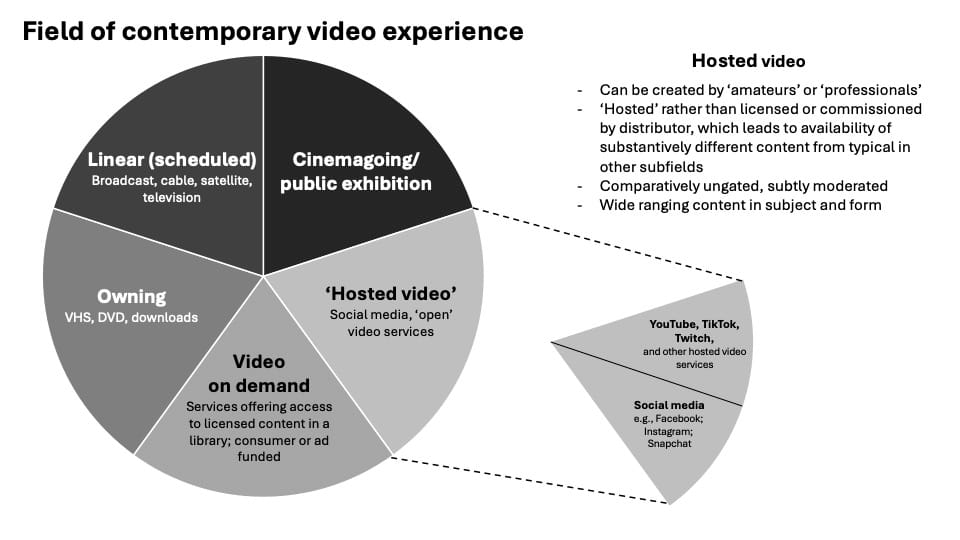
Part of the challenge of understanding the digital era has been pluriformity: a fancy word for how a more singular and consistent set of norms has given way to multiple, differentiated, coexisting norms. It hasn’t been a linear transition from A to B, but A persists alongside B, C, and AB (in words, linear television and streaming on-demand and YouTube, and streaming linear) (See Fig 2.1). This example uses video but similar illustrations can be drawn in other sectors.
The last quarter century has not been – as most expected – a shift from one norm to another, but from one norm to many concurrent business models, especially in television/video. Streaming has not 'replaced' linear and cinemagoing (as happened to the horse-drawn buggy), which were long the only ways to experience video, at least until rental/purchase joined in the 80s. Different from that evolution, which mostly offered more opportunity to access the narrow array of content designed for the mass market, the hosted media economy complements (in its content offering) and competes (for our time and money). Now we have linear and cinemagoing and rental/purchase and streaming VOD and hosted video (YouTube, TikTok, and video on social). Few are pure substitutes, the extent to which they compete varies by user profile and what motivates their use.
We struggle to make sense of this multiplicity. Although ‘old’ sectors have mostly not ‘died’ as predicted, the loss of attention and revenue have forced changes to operation that nevertheless befuddle those mired in old norms.
Accepting a pluriform ecosystem means:
- avoiding simple and hyperbolic constructions of competition (creators v corporate – nope, both)
- building businesses not based on prioritizing scale and mass reach above all else
- focusing on the value you provide and developing at a scale that matches the user base that also values it.
Another challenge is unacknowledged sector collapse that has made the scale of ‘competition’ incomprehensible using historical organizations of ‘print’, ‘television’, etc. There was a lot of talk about ‘convergence’ in the hype-fueled early days of new media. We weren’t always talking about it in the same way, but there was reason to expect convergence in technology, business organization, and media forms. Technological convergence arrived as single machines (the laptop, mobile ‘phone’, and increasingly the ‘connected’ living room ‘tv’) assumed capabilities that had required several distinct and non-interoperative devices. The mobility of the phone is a crucial adjustment, less for its out-of-home functionality but for reducing the friction of media use within the architecture of life so that video and audio can be used as fluidly as print.
Much of that convergence was structured into standard media operation by companies once in different legacy media sectors that continued conglomeration that began in the 1980s; they then merged with ‘new media’ companies, or simply evolved to erase the legacy/digital distinction. Video was freed from ‘television’ and ‘cinema’; ‘news’ became ubiquitous (though journalism remains scarce), etc. – all emblematic of convergence that may be more usefully understood as sector collapse from the vantage of the user.
There was a time of separated and distinct media sectors. Print and television both sought viewers’ attention and advertisers’ dollars, but the media goods they offered were not interchangeable to consumers. This enabled a complementarity that suited both sectors’ expenditure on content to attract attention. Today, all media sectors can fulfil the same needs for users (see 8 on motive), and this diminishes the value of sector-based thinking.
A user who wants to escape after a long day can now just as easily slip into a movie on Netflix, a social media feed, or several levels of a favorite game. Similarly, a user seeking to catch up with the news of the day can scroll a feed, turn on a live or on-demand newscast, or skim the headlines on a major news site. Of course these sectors have long ‘competed’ for users’ time and money, but the offerings across sectors were more distinctive in the past. Now users can fulfil any motive through the content available in any sector. Those looking for strategies need to think about why people would use the media content they offer (what’s the job to be done), promote their ability to do that job, and seek to do the job better than any other service.