How we use social media and YouTube
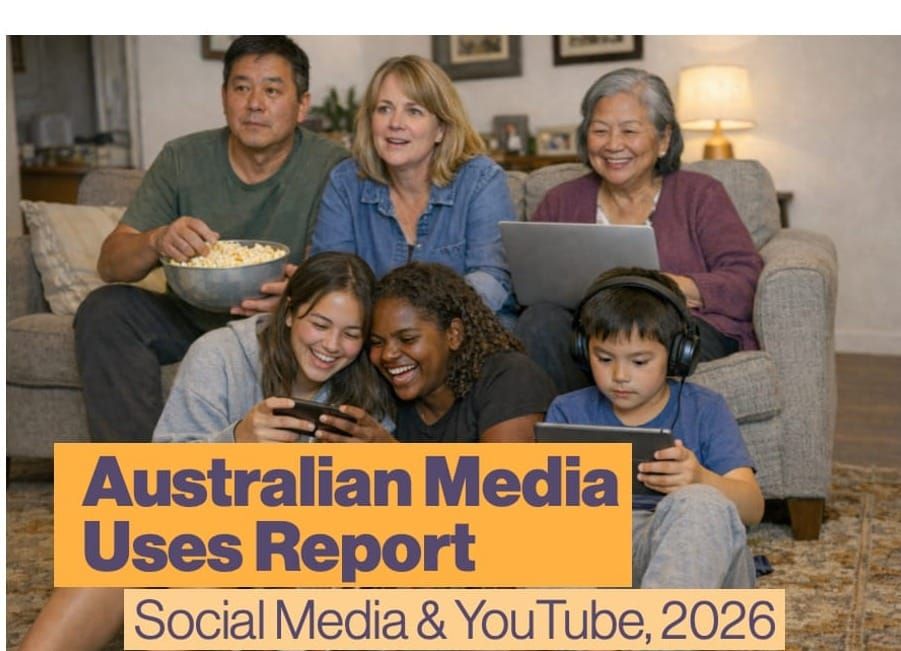
Background about and link to new survey and interview research: Australian Media Uses Report: Social Media and YouTube 2026
8 April 2026
I live with three other social media users, and I’m regularly astonished by the lack of overlap in our online worlds. Beyond living in different ‘corners’ of the internet, we prefer different services and use them in quite different ways. Curiosity about what other people do, what they love, and why they devote so much leisure to social media and YouTube gave rise to my current research project.
Social media use is profoundly personal. I see the other people in my house using social media but usually know little about what they are reading or watching. Sometimes there is a giggle; I mostly let out deflated sighs.
It is easy to assume your use is typical of others because we don’t use social media together in the way families and friends once watched television, listened to music, or even shared a newspaper. I promise you, your use is not typical. After 70 hour-long interviews and a nationally representative survey, I can tell you there is a lot of variation in what people do that adds to the extraordinary variety of content they see in their feeds or select to watch on YouTube. Some tendencies of use are more common, but social media use is surprisingly wide ranging. It is difficult to identify any typical experience.
For people in their fifties who are part of the ‘older adopter’ technology generation that reached adulthood before smartphones, YouTube, and social media were pervasive, social media can feel like media use in our teens, when houses down the block watched the same shows and read the same paper. Social media is disorienting this way: it feels like a conversation ‘everyone’ is sharing, but we’re mostly traversing islands of interest that only we’ve connected into a personal archipelago.
The report linked here explores all this in detail and presents data that hopefully proves useful to a wide range of debates and concerns. Our aim was to ask different questions than we’ve seen in market research or government studies; we don’t have an agenda beyond wanting to understand an important part of daily life for many people.
A few reflections here on some of the things about social media and YouTube use that most surprised me:
Social media is ‘social’ because of the amount of PRIVATE messaging and PRIVATE content sharing that happens there. Even among young adults (15–24-year-olds), posting in public feeds and features is uncommon (there may be a particular user type that regularly posts publicly, but they are unusual – like fewer than 3% of users unusual). Our data makes me wonder whether people ever really wanted to ‘Broadcast Yourself’ in the way an early YouTube slogan suggested or only posted publicly because that was the only option at first. Over the last 20 years, social media services have allowed us more private ways of sharing.
Posts and messages from people we know ‘in real life’ are our favorite part of social media use. Once people have steady jobs and families they have less time to share, so feeds of followed accounts, often related to personal interests, take on a greater role in daily use. Adults (25+) love the specificity of their feeds and the way they deliver precise interests. Some have feeds rich with a specific interest, others collect a variety of interests that no one other than that person would ever think to put together.
News is an extraordinarily small amount of what most people want or see in their social media use (again, there is a small contingent for whom news IS social media, but they rely on comparatively rarely used social media services such as X and are unusual relative to the broader population of users). But information is an extraordinarily significant and important part of social media and YouTube use.
Much of our feeds and YouTube use lets us learn more about things that interest us from people who have a sensibility or approach that we enjoy. Information encompasses pursuit of details and factual insight about sports, hobbies, well-being, travel – we heard about so, so many things: YouTube channels not just about gardening, but about growing tomatoes in Tasmania; about Tudor history; RV travel in Europe; how to fix things; bike races; airplane engineering; making guitars – a phenomenal range of fascinations.
The information accessible on social media and YouTube is truly amazing compared with predigital norms. We don’t talk enough about the difference of living in a digital era that allows us to answer most any basic question within seconds of having a curiosity. We also probably don’t talk enough about the risks of having few spaces or sources of reliable information that can be held accountable for inaccuracy.
The ‘digital first’ technology generation (age 25–35) is a really interesting one because they were largely ‘digital native’ and have moved out of the young adult life stage. It has been difficult to know what aspects of use from their youth might be hardwired for life and what bits of their teenage use was a matter of the amount of leisure and inclination toward self-discovery enjoyed by the young. This group offered fascinating accounts of how their social media use changed over time. The young adults (age 15–24) we interviewed – the start of ‘digital only’ generations – had quite different (less favorable) attitudes toward YouTube than the ‘digital firsts’ and suggested variation even among those who have lived in worlds of digital media much of their lives. (Our ‘technology generations’ are explained in the report and my Media 2025 long paper).
The other surprising result was about the role of social media in feeling community or connection. We need to do more rounds of interviews to dig into this further, but there was a notable difference between the pervasive LinkedIn commentariat, and even academic views, about the importance of ‘community’ in the use of social media and what people said about their use and motivations. At this point, it seems feelings of connection and community can be important, but this is only sometimes and not a priority for most people most of the time. Few were interested in connecting with ‘creators’ or others consuming the same content. More to come on this.